I Didn't Have a Discipline Problem. I Had a Distraction Problem.
7 reasons I stopped trying to fix my character and built a focus pill instead.
TL;DR: Procrastination gets sold to you as a willpower defect. Part of it is simpler: a tired brain makes starting feel expensive and every distraction feel cheap. Deadline is dosed for that part.
Every Sunday night I wrote the same plan. Every Friday I looked at the same list, mostly untouched, and told myself next week I'd finally be disciplined.
So I did what everyone says to do. App blockers. Pomodoro timers. Phone in the other room. A 5am experiment that lasted nine days. One dopamine detox weekend that mostly proved I can stare at a wall and still not write the deck.
Two good days. Then the relapse. Then the 11pm shame spiral. Repeat.
Here's the thing nobody in that entire industry ever said to me: maybe I wasn't failing at discipline. Maybe I never got to use any.
My discipline wasn't failing. It never got to play.
Watch the first ten minutes of "getting started." You sit down. The work feels vague and heavy. Your attention slides off it once, twice, ten times, and every slide has a phone-shaped landing pad. The task never gets refused. It gets interrupted to death.
Quick science, no lab coat: your brain runs a constant, unconscious cost calculation. How much effort does this cost, versus that other thing. On a foggy, tired, badly-caffeinated brain, deep work gets priced higher and the cheap option gets priced lower. Willpower is the tiebreaker. When it's ten against one, there's no tie left to break.
Deadline doesn't push you harder. It works on the price: everything in it exists to make focused attention cost less, so your discipline finally has something to work with.*
That's the whole thesis. The next six reasons are the receipts.
The first ten minutes stop being a war.

Starting is the expensive part. Every project I abandoned died at the start, never in the middle. Once I'm forty minutes in, I'm fine. I just couldn't reliably buy those first ten minutes.
Coffee is badly timed for exactly this. Caffeine from a cup takes 30 to 45 minutes to peak, which is precisely the window where you decide whether today happens. You white-knuckle the decision, then the help arrives after the verdict.
So Deadline uses two caffeine sources with different arrival times. Coffeeberry® (85mg) sits at the front of the curve; zümXR® time-release beads (111mg) meter the rest out over hours.* You take your dose, you sit down, and the ramp is already coming instead of being negotiated for.
The urge to click away gets quieter.*
Mid-sentence, mid-thought, mid-anything: check the phone, check the tab, check the fridge. Focus that constantly begs to leave isn't focus. It's supervision.
Psychologists have a name for the exact failure. In attention testing, a "commission error" is responding to something you were supposed to ignore. That's the lab version of opening a new tab. Not a moral event. A measurable one.
That's why Cognizin® citicoline is in here at a full 500mg, and it's the ingredient I'd defend hardest. In the published trials on this branded form, people taking it made fewer commission errors and showed lower impulsivity on standard attention tests.* Not vocabulary. Not memory. The specific ability to not take the exit.
Alongside it, 200mg of L-theanine takes the anxious edge off the caffeine.* What's left is a strange, calm kind of locked in. Not wired. Not sedated. Just fewer exits that look worth taking.
Procrastination is a mood problem. So we dosed for mood.
Be honest about the moment you bail. It isn't a scheduling conflict. It's a feeling: the task looks tedious, or hard, or like something you might do badly, and clicking away makes that feeling stop for a minute.
That's the current research consensus on procrastination, not a motivational metaphor: it's mood repair. You're not avoiding the work, you're avoiding how the work makes you feel. Which is why every "just be disciplined" video fails. It argues with the decision and leaves the feeling intact.
Deadline carries TeaCrine® theacrine (50mg) and Dynamine™ methylliberine (75mg), and the honest reason is unusual enough to spell out.
In the trials on methylliberine, the things that moved were mood, motivation, energy, well-being and the ability to tolerate stress. Objective cognitive scores didn't.* Most brands would bury that. I think it's the point: the studied effect is on how you feel about doing the thing, and how you feel about doing the thing is where procrastination lives.
Theacrine brings its own piece: in its studies, ratings of lethargic and groggy went down while energy and focus went up, and across eight weeks of daily use those ratings held with no habituation, which caffeine cannot claim.*
And the published research on this exact pairing, 75mg methylliberine with 50mg theacrine alongside caffeine, measured improved inhibitory control, while caffeine on its own raised self-reported anxiety.* We didn't pick those numbers off a marketing sheet. We matched the doses that were studied.
The 2:30 relapse window closes.
There's an hour where good intentions reliably go to die, and for most people it sits somewhere around 2:30. It's the hour the couch wins and "I'll finish it tonight" gets said out loud.
Quick science again. Caffeine doesn't create energy. It blocks the signal that tells you you're tired (adenosine, if you want to impress someone at lunch). Slam a big morning dose and that signal gets blocked hard, but the tiredness doesn't leave. It queues. Around 2, the caffeine lets go and the whole queue arrives at once. More caffeine at 3 just reschedules the avalanche for 5.
We changed the release, not the molecule: time-release beads mean the queue never dumps on you at once.* No wall, nothing to push through, and an evening where you're actually there instead of recovering.
Every ingredient earns its place. And it's the expensive version.
No "proprietary blend." Full doses, printed on the label:
A drip line, not a firehose. Metered over hours.*
Whole-fruit caffeine at the front of the curve.*
Studied on attention and impulse control: fewer of the errors where you respond to what you meant to ignore.*
Smooths the stimulant edge.*
Studied on mood, motivation and steady energy, with no habituation across eight weeks.*
So deadline stress doesn't eat the focus you just built.*
Now the ® symbols, because they're not decoration. Most ingredients exist twice: the branded original the published studies were run on, and a generic copy that costs a fraction and often has no research behind it at all. Guess which one usually goes in the bottle.
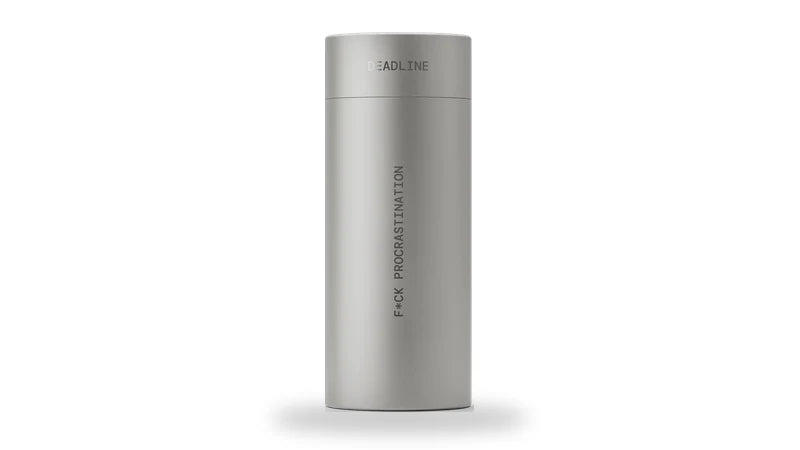
Six of our seven actives are branded originals. Our margin is thinner for it. That's the trade we chose: you get the version that was studied, not the version that was cheapest that quarter.
You don't have to trust yourself. Or me.
If you've broken enough promises to yourself, "just trust the process" is a hard sell. You've bought optimism before. It didn't ship.
So don't trust it. Measure it. Every Deadline order includes our cognitive benchmark: test yourself before day one, re-test at day 30, and read your own numbers. No focus supplement ever handed you a way to call its bluff. This one does.
And if the numbers are boring, you pay nothing. You try it for up to 90 days. If it's not for you, one email and your money comes back. Empty bottle included. No return label, no store credit, no "have you tried taking it with food" interrogation.

Worst case of trying Deadline: you ruled out one more thing, for free. Worst case of not trying it: another quarter of identical Mondays.
One more thing, because it's real: the founding batch is on pre-launch pricing right now. $69 for your first month instead of $129. Batch 1 is a fixed production run, and the price ends when it sells out.
Pre-order v1.0: Founding Batch
What you get:
- Deadline Focus Pill v1.0 (30 servings):$69 first month
$129(47% pre-launch discount) - Cognitive benchmark, before/after:included
- v1.1 patch notes before anyone else:included
- 90-day money-back guarantee:standard
Pre-order special
Founding batch is a fixed run. Pre-launch pricing ends when batch 1 sells out.
90-day guarantee · Cancel anytime · Ships August 5
Your life has a deadline. Start like it.